Conference Paper
IAC 2024: Beyond ELSA-d - Developing Commercial Viability of Multi-Client Servicing with ELSA-M
Abstract
Large commercial satellite constellations in low Earth orbit (LEO) provide essential services but increase the number of objects in key orbits. This raises the risk of further debris creation and could ultimately make these orbits unusable for future generations. Commercial services for post-mission disposal are widely encouraged through government and agency policies (such as ESA’s Zero Debris policy) to maintain the safe use of LEO orbits for the benefit of humankind.
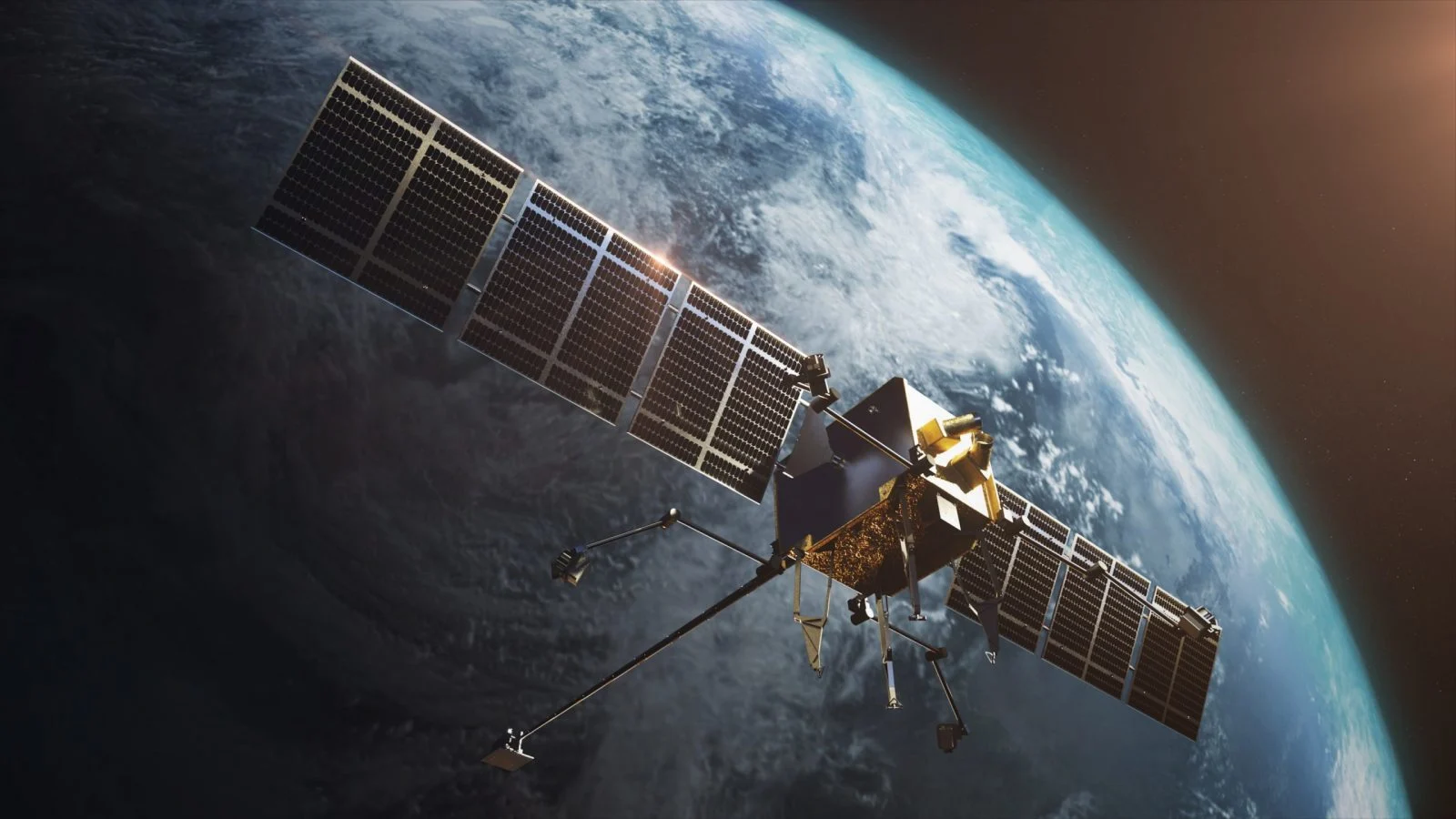
Astroscale launched its End-of-Life Services by Astroscale – Demonstrator (ELSA-d) mission in March 2021 to perform in-orbit demonstrations of core Rendezvous and Proximity Operation (RPO) capabilities necessary to achieve debris removal. The successor Multi-Client mission, ELSA-M, will build upon ELSA-d to develop a service which can remove multiple clients. It involves sequentially moving to clients, docking with them via a prepared docking plate interface, lowering their orbits, and facilitating their uncontrolled re-entry before moving on to the next client. ELSA-M is commissioned and developed by Astroscale Limited in the Sunrise Public-Private Partnership Project, part of the European Space Agency’s (ESA) Advanced Research in Telecommunications Systems (ARTES) programme and based on funding provided to Eutelsat OneWeb by the UK Space Agency via ESA. The programme has been in development since 2018 and is currently progressing towards Critical Design Review.
This paper explains the critical technical developments (space segment and ground segment) that have been required to mature from ELSA-d to the ELSA-M commercial servicer. Details are provided on the following mission enabling elements: a concept of operations to realise the capture of a OneWeb client spacecraft; the RPO sensor suite to support short-range and long-range RPO manoeuvres; Guidance Navigation and Control and Computer Vision algorithms essential for supporting closed-loop RPO manoeuvres; Astroscale’s magnetic capture system to ensure safe docking and compatibility with client spacecraft; supporting ground segment capabilities, such as the Flight Dynamics System to determine the position and the orientation of satellites; and the operations support required to plan and execute manoeuvres in-orbit.
This paper provides further details on how Astroscale has approached enabling services, such as insurance, regulation, and policy, which in some instances are being addressed for the first time for debris removal services.
The ELSA-M in-orbit demonstration is planned to launch in early 2026 and will be the world’s first prepared satellite debris removal mission conducted with a full-sized representative constellation customer in OneWeb.