Astroscale Patent Advances Docking and Servicing of Tumbling Satellites
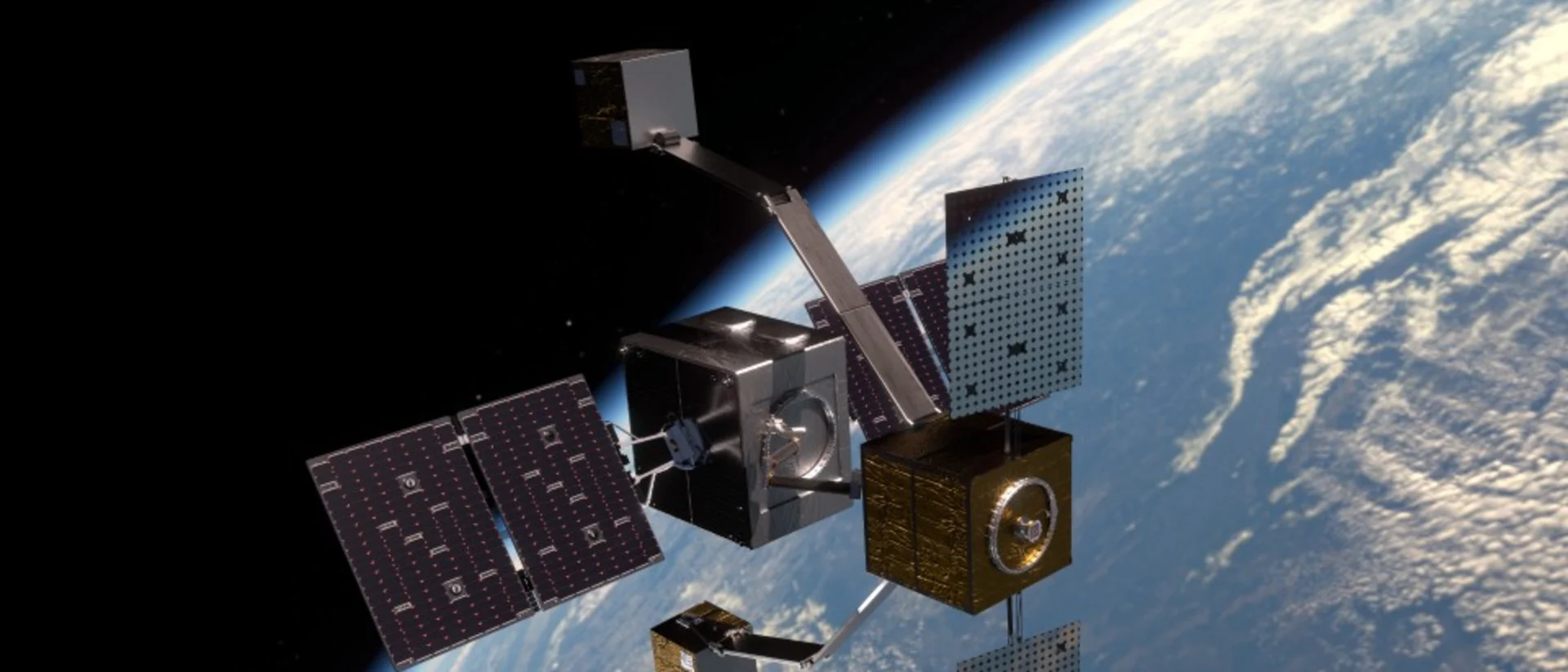
Innovation enables fuel-efficient capture of spacecraft, unlocking future in-orbit assembly and serviceability.
Tokyo, Japan, Dec. 16, 2025 – Astroscale Holdings Inc. (“Astroscale”), the market leader in satellite servicing and long-term orbital sustainability across all orbits, announces the issuance of U.S. Patent No. 12,479,603 B2, “Method and Device for Capture of Tumbling Space Objects.” The innovation introduces a novel spacecraft design with an “empty” docking volume and center-of-mass control technique that will allow Astroscale servicers to approach and synchronize with client satellites more precisely, more safely and with far less fuel, even if they are tumbling. The method marks a major advance in Astroscale’s on-orbit servicing capabilities and lays the foundation for a future in which satellites transform from limited, single-use systems into fully serviceable assets.
Current approaches to capturing tumbling satellites inherently carry greater risk. Uncontrolled rotation means physical contact — required for nearly any servicing activity — can trigger shocks or fragmentation that worsens the debris problem. Astroscale’s patented method mitigates these hazards by allowing a servicer to match a client’s tumble rate before capture without using fuel or propulsion. The technique involves deploying counter-masses to shift the servicer’s center of mass into an empty clearance volume. Aligning the centers of gravity of the servicer and client allows both objects to orbit together without requiring contact, propulsion, or control of relative rotation rates. Once aligned, the servicer can use angular momentum to mirror the client’s rotation and then establish mechanical attachment, such as with a robotic arm, at effectively zero relative rotation. When stabilized and secured, the client becomes accessible for a wide range of servicing activities, including refueling, repair, relocation and maintenance.
The patent also expands what is possible with a stable client. Its design enables the servicer to safely reposition itself around the client without firing thrusters, allowing it to move between different panels of the client. Traditional servicing methods are often constrained by whatever a single robotic arm can reach from a fixed docking point. By contrast, this approach allows the servicer to move freely around the client — a capability that dramatically broadens what can be repaired, inspected or upgraded in orbit. It also supports future in-orbit assembly by enabling capture and management of uncontrolled components and modules, allowing operators to build and expand larger orbital platforms over time. Together, these advances make it possible to design spacecraft with more comprehensive serviceability in mind — a crucial step toward achieving a circular space economy.
“Fuel and agility have always been significant challenges for satellite servicing,” said Mike Lindsay, CTO of Astroscale. “Imagine synchronizing with a 3-degree-per-second tumble rate, or repairing the forward deck of a spacecraft and then needing to refuel the aft, or trying to maintain a constant two-meter clearance from an object in an elliptic orbit. All of these activities require fuel and repeatedly firing thrusters near the client, but this patent eliminates that.”
Astroscale continues to grow its portfolio of patented technologies designed to advance sustainable on-orbit operations. In July, the company announced its “Method and System for Multi-Object Space Debris Removal,” which enables a distributed, scalable and cost-effective architecture for active debris removal and controlled reentry of multiple objects. Together, these innovations reinforce Astroscale’s commitment to building the services, technologies and operational concepts required for a circular space economy in which space systems can be maintained, upgraded and responsibly retired.
END
Translation
Translations are machine-generated and may not be perfect.
All Categories
Recent Posts
Astroscale UK Strengthens Mission Readiness for World’s First Active Debris Removal Mission
September 30, 2026ESA's Space Environment Report Shows a Growing Gap Between Space Growth and Sustainability
September 15, 2026Astroscale France and HEMERIA Join Forces to Develop Sovereign GEO Capability for Global Markets
September 15, 2026